
Se opptak fra Likestillings- og diskrimineringsombudets presentasjon av den første rapporten til FNs komité for rettighetene til mennesker med nedsatt funksjonsevne (CRPD-komiteen). WSOs Mette Ellingsdalen deltar fra brukerutvalget.
Les også: Omtaler i Handikapnytt og Fontene
Viser innlegg med etiketten Tvang. Vis alle innlegg
Viser innlegg med etiketten Tvang. Vis alle innlegg
20.10.15
2.9.15
9.8.15
Om domstolsprøving av tvangsvedtak
Masteroppgave som kanskje kan være informativ for tvangsberørte: Domstolsprøving av tvangsvedtak innen psykiskhelsevern
18.5.15
Europarådets Menneskerettighetskommisærs rapport fra Norges-besøket i januar
Strasbourg, 18 May 2015
CommDH(2015)9
English only
REPORT
BY NILS MUIŽNIEKS
COMMISSIONER FOR HUMAN RIGHTS OF THE
COUNCIL OF EUROPE
FOLLOWING HIS VISIT TO NORWAY
FROM 19 TO 23 JANUARY 2015
(..)
However, the Commissioner points out that the
implementation of the CRPD in Norway falls short of some of its key objectives in promoting the
self-determination, legal capacity and effective equality of people
with psycho-social and intellectual disabilities.
The best interest considerations continue to prevail over the CRPD approach highlighting the person’s autonomy, will and preferences. The new Guardianship Act, which entered into force in 2013, still enables substituted
decision-making and plenary guardianship with reference to
psychosocial
and intellectual disabilities. This is not in
line with CRPD Article 12. The Commissioner is also concerned that the guardianship model hinders the
development of supported decision-making alternatives for those who simply want assistance in making decisions or
communicating them to others.
The Commissioner urges the Norwegian
authorities to develop new systems for supported decision-making, based on individual consent. Such systems
should be developed together with people with disabilities and along with measures for universal design and
reasonable accommodation. Plenary guardianship and full incapacitation regimes should be revoked as a
matter of priority, and information should be made available on the scope of guardianships applied under the
current system.
The Commissioner welcomes the Norwegian
national strategy 2012-15 to reduce the use of coercion in mental health care but stresses that a more
comprehensive approach, including legislative reforms, will be required
to bring about fundamental changes. There is a
clear European trend towards reinforcing the rights and
selfdetermination of patients and their participation in
decisions about care, and people with psycho-social disabilities should not be excluded from this
development. All people with disabilities have the right to enjoy the highest attainable standard of health
without discrimination and the care provided to them should be
based on free and informed consent in line with
Article 25 of the CRPD.
The Commissioner calls on Norway to reform
legislation on involuntary placements in a way that it applies objective and non-discriminatory criteria which
are not specifically aimed at people with psycho-social disabilities. Precise data on the use of
involuntary medical treatment and restraints in Norway should be made available with a view to drastically reducing
the recourse to such practices. Medical treatment should be based on free and fully informed consent with the
exception of life-threatening emergencies when there is no disagreement about the absence of legal
capacity. The Commissioner is not convinced that the documented involuntary use of ECT in Norway is in line
with human rights standards.
NTRODUTION
1 HUMAN RIGHTS OF PEOPLE WITH
DISABILITIES2
1.5 CONCLUSIONS AND RECOMMENDATIONS
36. While the Commissioner commends Norway for
ratifying the CRPD, he points out that the
implementation of the Convention in Norway
falls short of some of its key objectives in promoting the self-determination, autonomy, legal capacity
and effective equality of people with psycho-social and intellectual disabilities. The best interest
considerations and substituted decision-making continue to prevail over the CRPD approach highlighting the
person’s autonomy, will and preferences. The
Commissioner urges the government to adopt a
more pro-active stance in implementing its obligations under the CRPD in close cooperation with people
with disabilities and organisations representing them.
37. In the
Commissioner’s opinion, the withdrawal of Norway’s interpretative declarations
concerning the CRPD would signal a new approach. The
Commissioner also encourages Norway to sign and ratify the Optional Protocol to the CRPD on an individual
complaints mechanism which would improve the access of people with disabilities to external review
of their concerns.
38. The Commissioner acknowledges that the
Norwegian authorities have attempted to develop some
elements of supported decision-making in the
context of the new Guardianship Act and that the number of people put under guardianship with a loss of
legal capacity is relatively small. However, he points out that the new guardianship system continues to
enable substituted decision-making and plenary guardianship and hinders the full development
of supported decision-making alternatives for those who simply want assistance in making decisions or
communicating them to others.
39. In order to fully comply with the
requirements of Article 12 of the CRPD, the Commissioner urges the Norwegian authorities to develop new systems
for supported decision-making alternatives, based on individual consent. Such systems should be
developed in coordination with measures for universal design and reasonable accommodation, and
together with people with psycho-social and intellectual disabilities. Robust safeguards are needed to
ensure that any support provided respects the will and preferences of the person requesting it and is
free of conflict of interests. Plenary guardianship and full incapacitation regimes should be revoked as a
matter of priority and information should be made available on the scope and specific conditions
of guardianships applied under the current system.
40. The Commissioner welcomes the Norwegian
national strategy to reduce the use of coercion in mental health care but stresses that a more
comprehensive approach, including legislative reforms, will be required to bring about fundamental changes.
There is a clear European trend towards reinforcing the rights and self-determination of patients and
their participation in decisions about care, and people with psycho-social disabilities should not be
excluded from this development. All people with disabilities have the right to enjoy the highest attainable
standard of health without discrimination and the care provided to them should be based on free and informed
consent in line with Article 25 of the CRPD.
41. Having regard to Article 14 of the CRPD
(Liberty and security of the person), the Commissioner urges the Norwegian authorities to reform legislation on
involuntary placements in a way that it applies objective and non-discriminatory criteria which are not
specifically aimed at people with psycho-social disabilities, while ensuring adequate safeguards against
abuse for the individuals concerned.
42. The Commissioner points out that precise
data on the use of involuntary medical treatment and
restraints in Norway, including the length of
their application, should be made available with a view to drastically reducing and progressively
eliminating the recourse to such coercive practices. The
availability of supported decision-making
alternatives and reasonable accommodation measures can
contribute significantly towards the
development of alternatives to coercion. The Commissioner stresses that medical treatment should be based on free
and fully informed consent with the exception of lifethreatening emergencies when there is no disagreement
regarding absence of legal capacity. The Norwegian Patient and User Rights Act (Chapter
4A) also highlights this principle.
43. It is essential that the use of highly
intrusive treatments such as ECT is subject to robust safeguards. The Commissioner is not convinced that the
documented involuntary use of ECT in Norway with reference to the “principle of necessity” in the Penal Code
(Article 47) is in line with human rights
standards, including the provisions of the CRPD. The
Commissioner points out that particular care should be taken to ensure that information given by health
professionals about ECT is correct and complete, including information on secondary effects and related
risks, so that patients are able to express their free and fully informed consent to the procedure. It is
also necessary to collect precise data on the use of ECT and make this available to the public. During
the visit, the Norwegian authorities informed the Commissioner of their intention to issue
national guidelines on the use of ECT and the Commissioner welcomes this development.
44. In the
Commissioner’s opinion, a comprehensive approach towards reducing coercive measures on
people with psycho-social and intellectual
disabilities needs to cover a range of different settings in
addition to specialised psychiatric
institutions. The intention of the Norwegian authorities to include
municipal care staff in the scope of their
future national guidelines on reducing coercion is
commendable. Cooperation between local and
specialised care providers will be useful in this context.
The Commissioner points out that the use of
coercion in nursing homes and in educational settings should also be addressed.
25.3.15
Hurra for Natalie!
I forbindelse med at Paulsrud-utvalget leverte sin innstilling om tvang i psykiatrien i juni 2011, ble Natalie intervjuet om sine erfaringer på Dagsrevyen. Etter et traume fikk hun diagnosen schizofreni - som de senere igjen mente var feil - og ble tvangs"behandlet" i to år. Hun lå over 200 timer bundet fast til en seng.
- Tvang har ikke noe med behandling å gjøre. Tvang er tortur, sa Natalie.
Som følge av intervjuet fikk hun etterpå sparken fra jobben sin.
Nå utdanner hun seg til psykolog, og hun er bokaktuell med På den gale siden.
Nå utdanner hun seg til psykolog, og hun er bokaktuell med På den gale siden.
12.11.14
Workshop om krenkelser i behandling og kurs om CRPD
Arrangement 1
Senter for medisinsk etikk i Oslo inviterer til workshop for mennesker som har opplevd tvang eller krenkelser i behandling innen psykisk helsevern.
Forskeren som leder workshopen stiller blant annet spørsmålet: Når kan man karakterisere en opplevelse med tvang som uforenelig med menneskerettighetene, og hvorfor?
Les saken hos Erfaringskompetanse.
Arrangement 2
Unge Funksjonshemmede inviterer til kurs om FN-konvensjonen for funksjonshemmedes rettigheter (CRPD) 5. desember. Gratis, men man må melde seg på. Les mer
28.4.14
Norge svarer for MR-praksis i FN: Universell periodisk undersøkelse
Utenriksminister Børge Brende: 00:07:59
Italia: 00:31:06
New Zealand: 00:47:49
Sveits: 01:41:33
Utenriksminister Børge Brende: 03:16:18
11.4.14
Kritisk til norske tolkningserklæringer
 Førsteamanuensis Vibeke Blaker Strand ved Senter for menneskerettigheter har skrevet en artikkel om CRPD kalt "Norway's Ratification of the UN Convention on the Rights of Persons with Disabilities: Highlighting Current Discourses in the Field of Human Rights in Norway". Utdrag:
Norway has never before issued such relatively broad declarations that relate to treaty interpretation in the field of human rights. There are a few examples of Norway issuing reservations/declarations to human rights treaties but all of these have been narrowly formulated and are related to concrete provisions in domestic legislation. Most of these reservations/declarations have been withdrawn and those remaining are not controversial. In fact, Norway's policy on reservations and declarations has previously been not to submit these legal caveats upon signature. Rather, Norway's policy has been characterised by objecting to other states’ reservations and declarations, particularly those the Norwegian government considers to be incompatible with the object and purpose of the conventions.
Artikkelen kan leses i fulltekst her.
Mer om menneskerettigheter: FN ber Norge om å slutte med tvangsinngrep (wso.no)
4.4.14
Dag og Tid underslår langt på vei behandlingskriteriets eksistens
Eskil Skjeldal intervjuer psykiater Marit Bjartveit i Dag og Tid. Artikkelen underslår helt eksistensen av behandlingskriteriet. Psykiateren sier om tvangsinnleggelse:
I så fall må pasienten ha ei alvorleg psykisk liding. Men det åleine er ikkje nok. Lidinga må òg innebere ein alvorleg risiko for skade på helse eller liv for ein sjølv eller andre, altså sjølvmordsrisiko og/eller valdsrisiko.
Og:
Nokre har det betre med vrangførestellingane i psykosen og ynskjer ikkje å kome ut av han. Om dei då ikkje er farlege for seg sjølve eller andre, så kvalifiserer dei ikkje for tvunge psykisk helsevern.
Skjønt avsnittet fortsetter:
Difor er tilleggskriteria om behandling og overlast òg viktige. Men då kjem diskusjonen: Kven veit kva som er best for pasienten, når skade og fare for liv er tekne bort? Her er psykiatrien i dialog med pasient og pårørande.
Her nevner hun behandling som tilleggskriterium, men det motsier påstanden ovenfor om at "lidinga må òg innebere ein alvorleg risiko for skade på helse eller liv for ein sjølv eller andre". Psykiateren nevner også overlastkriteriet, som ble fjernet i 1999!
30.3.14
På TV i kveld
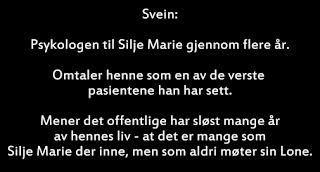
I kveld kan du møte Silje Marie på TV2. Hun var tvangsinnlagt i ti år, men møtte så en helt spesiell sykepleier, som gjorde det lille ekstra hun trengte.
 |
| Skjermdump fra YouTube-video |
27.3.14
"Psykiatriske pasienter liker å bli lagt i belter"
To studenter ved Høgskolen i Oslo og Akershus lager belter til beltesenger. Den ene uttaler til avisa Khrono:
[Det er] mange ting som er viktig å tenke på når man jobber med psykiatriske pasienter. Mange av dem liker oppmerksomheten det er å bli lagt i belter, så det gjelder å finne en fin balanse slik at de ikke ønsker å bli lagt i belter. Vi skal ikke ufarliggjøre det.
[Det er] mange ting som er viktig å tenke på når man jobber med psykiatriske pasienter. Mange av dem liker oppmerksomheten det er å bli lagt i belter, så det gjelder å finne en fin balanse slik at de ikke ønsker å bli lagt i belter. Vi skal ikke ufarliggjøre det.

23.3.14
"Motstand mot medisiner et eksempel på manglende sykdomsinnsikt"
"Biologiske årsaksmodeller synes ... å være bredt akseptert blant behandlerne, selv om det varierer en god del hvordan man vekter dette i forhold til andre faktorer. Den mest foretrukne formen for psykoterapi blant de intervjuede synes å være kognitiv. Begge disse tilnærmingene har en fordel i forhold til samarbeid med de pårørende, da de ikke fokuserer på "gamle synder" og foreldrenes eventuelle "skyld" i hovedpersonens lidelser. Et klart "her og nå" perspektiv er kanskje også enklere å bruke som utgangspunkt for et samarbeid mellom mange ulike tjenester og fagpersoner."
"Vi opplevde det slik at svært mange av behandlerne tenkte på diagnosene som reelle sykdomskategorier. Mest illustrerende er dette kanskje når vi diskuterte schizofreni-diagnosen. Når vi viste til personer som hevdet offentlig at de var blitt helbredet av schizofreni, stilte enkelte behandlere spørsmålstegn ved selve diagnostiseringen i utgangspunktet. Til tross for at de anså schizofreni som svært uutforsket og en "sekke-diagnose". Dette er tautologisk tenkning: Schizofreni betraktes som en kronisk sykdom. Dersom noen helbredes av schizofreni, betyr det simpelthen at de ikke var schizofrene."
"Når vi spør om hvordan tvangstiltakene oppleves av brukeren, er det typiske svaret at de [ansatte] selv sjelden har opplevd at noen mente det var feil eller et overgrep, i ettertid".
"Spørsmål om bivirkninger ble stort sett besvart med at dagens praksis innebærer mindre og riktigere doser og at det nå har kommet langt bedre medisiner enn man hadde tidligere. Vi sitter imidlertid igjen med en følelse av at akkurat dette har vi hørt før, når nye medikamenter introduseres. Det var vanskelig å finne legitime argumenter mot medisiner i det behandlerne sa, og flere brukte motstand mot medisiner som eksempel på manglende sykdomsinnsikt."
"Behandlernes ekspertposisjon ble det i liten grad stilt spørsmål ved, slik vi tolker det. Dette til tross for mange understrekninger av at det er brukeren som er "ekspert på sitt liv". Den overordnede medisinske modellen gir behandlerne den endelige definisjonsmakten og vi tolker ikke behandlingsmøtene som et reelt fora for å la brukerekspertisen utfordre ekspertkunnskapen."
"Behandlerne argumenterte både for å øke adgangen til tvang og for å begrense den faktiske bruken av den mest mulig."
Fra Diaforsk-rapporten Holdninger, erfaringer og strukturer : fagpersoner i psykisk helsearbeid (fulltekst)
26.2.14
Tilskudd til "Riktig og redusert bruk av tvang i psykisk helsevern"
Hvem kan søke
Statlige mottakere, Stiftelser, Kommuner, Organisasjoner
Søknadsfrist
1. april 2014
Mål for ordningen
Økt frivillighet, kvalitetssikret bruk av tvang, økt kunnskap og bedre dokumentasjon av tvangsbruk.
Målgruppe
Personer som har behov for helsehjelp i psykisk helsevern.
Andre opplysninger
Det legges vekt på at mottaker har nødvendig kompetanse og gjennomføringskapasitet, samt har et godt brukerperspektiv.
16.2.14
Svensk forskning på etikk i psykiatrien
 |
| Foto: Stuart Miles/freedigitalphotos.net |
Staffs’ perceptions of the ethical landscape in psychiatric inpatient care: A qualitative content analysis of ethical diaries (abstract)
Rapport på svensk: På väg mot en värdebaserad psykiatri – ett utvecklingsprojekt kring etiska dilemmanoch värdegrundsarbete i psykiatrin
13.2.14
Paneldebatt om alternativer til tvang
Erfaringskompetanse har lagt ut en video fra paneldebatten om alternativer til tvang på Litteraturhuset i går.
Fra WSO deltok nestleder Liv Skree.

Fra WSO deltok nestleder Liv Skree.
5.2.14
WSOs nestleder deltar om tvang på Litteraturhuset
Har du lyst til å høre hva tidligere pasienter i psykisk helsevern mener kan gjøres for å redusere bruken av tvang? Og vil du vite hva forskerne tenker om forslagene fra brukerne? Da bør du ta turen til Litteraturhuset i Oslo på mandag. Fra WSO deltar vår nestleder Liv Skree.
Les mer
Les mer
Abonner på:
Innlegg (Atom)